Yes, Its the empire march. Microsoft is suing TomTom for patent infringement in U.S. Patents:
6,175,789; 7,054,745; 6,704,032; 7,117,286; 6,202,008; vfat: 5,579,517 ; 5,758,352; and 6,256,642 .
TomTom is a European company using a gnu/linux platform. Even though TomTom is pretty large, its a pressing moment with the financial crisis for everyone. Lets hope that they can stand the pressure from Redmond.
TomTom's CEO saying that they spend more money on patentlitigation than on R&D:http://www.youtube.com/watch?v=bSOIK-tlN8g
Groklaw has the complaint at http://www.groklaw.net/pdf/tomtomComplaint.pdf and a good recommendation: "Think Bilski"!
Update: Case settled out of court. Its incredible how naive most of these patents are, just watch the claims in the comments. Still they survive at the expense of development and competition. More at groklaw


2009-02-02
Action: EPO court needs your statements on software patents
The January Official Journal of the EPO contains the announcement of the EPO President's referral on software patents and notes that:
"It is expected that third parties will wish to use the opportunity to file written statements in accordance with Article 10 of the Rules of Procedure of the Enlarged Board of Appeal (OJ EPO 2007, 303 ff). To ensure that any such statements can be given due consideration they should be filed together with any new cited documents by the end of April 2009 at the Registry of the Enlarged Board of Appeal, quoting case number G 3/08. An additional filing of the statement and documents in electronic form would be appreciated"
Dg3registry_eba @ epo.org
You should snail mail the your statement too as that e-mail address is complementary as said.
Email seems to be the "additional" way send statements, as commented by annonymous on IPKat:
" It follows from these requirements that a document only sent by e-mail does not, at present, appear to fulfill the conditions of "filing a written statement" in the meaning of the EPC."
My previous answer needs some refinements before i post it... though. Comments appreciated!
UPDATE 20090305: EPO Questions OCR:ed and commented at FFII
UPDATE2: EPO seems to have updated its software patents page and replaced moderate texts with pro patent politics. The EPO patent extremists are running wild on:
http://www.epo.org/topics/issues/computer-implemented-inventions/software.html
Compare this with the previous information, still available at:"According to some, granting patents for computer-implemented inventions stimulates innovation because the financial and material investment that is needed to develop sophisticated and specialized software is protected. Others, however, believe that such patents stifle competition and act as a brake on innovation."
http://web.archive.org/web/20070205233052/http://cii.european-patent-office.org/
Happy new year!
ArsTechnica reports the good news that another patent has been invalidated with the Bilski case in mind. BPAI (the court) noted that the claims do not "recite any machine or apparatus or call for transforming an article into a different state or thing. A domain name is simply a series of characters representing the address of a resource, such as a server, on the World Wide Web. All of the steps are data manipulation steps."
I like the way that sounds. Its an acknowledgement that data processing should not be pantentable on its own.
ArsTechnica also published a great review over the history and future of software patents in the US in
"a return to the Supreme Court's software patent ban?"
2008-11-27
Bliski works in practice!

PatentlyO reports that Court finds “Programmed Computer Method” Not Patentable Subject Matter!
This is certainly good progress in eliminating the abstract patents we have seen granted for quite a while.
There is also an update on the effects of Bilski on Groklaw using Microsofts patent portfolio as an exemaple.
2008-11-20
TED: Patents and copyrights stopping innovation?
Charles Leadbeater, journalist from the Financial Times talks about real innovation and how the image of inventors is bad for development on TED-talks.
Charles argues that innovation comes from consumers and its up to companies to listening to and understand consumers.
2008-11-10
EPO can't hide from Bilski

US patent praxis is now much clearer than EPO praxis. After a US court declared business methods and logic invalid in the Bilski case, Europe has to catch up.
Perhaps its the sub prime crisis that made the risk in the current patent inflation that obvious? My guess is that the court just used good old reason about keeping abstract matter out of patents at last!
While EPO argues that further technical effects, like running anything on a standard computer, allows for business methods and software patents, US has declared out... for real!
Any claims on abstract methods or information (aka record on a carrier) publication are out, while apparatus claims remain.
Europe has to tame the beast at the EPO or fall behind.
2008-10-31
US court puts limits back on whats patententalbe - Woo!

Groklaw writes that its time to pop the Champagne over the recent US court decision, re Bilski.
The decision states: "Applicants' claims are not directed to patent-eligible subject matter, and in doing so, we clarify the standards applicable in determining whether a claimed method constitutes a statutory "process" under § 101."
This means death to most business method patents or at least to the State Street interpretation that has created a huge patent bubble for some years.
WSJ makes a reference to the case that set off software and business method patents "State Street":
"This is a pretty clear disavowal of State Street," said Daniel Crowe, a patent litigator at Bryan Cave LLP in St. Louis who was not involved in the case. "It's a ruling against the financial services industry." Mr. Crowe said he did not know what would happen to the business-method patents validated within the last 10 years. "That's definitely an open question."
In another WSJ article Randy Lipsitz, a patents specialist at Kramer Levin says:
“You’re going to see fewer applications from these industries,”
IBM seems pleased in a Business Week article:
Kappos said IBM was “very pleased” with the court’s decision. “It doesn’t spell the complete demise of business-method patents,” he says, “But without question it points to a major downsizing.”
I think this report at VentureBeat makes it very clear what just happend:
"The ruling clarified what types of patents the court found eligible: “(1) it is tied to a particular machine or apparatus, or (2) it transforms a particular article into a different state or thing.” Ten years ago, the same court had ruled that a “useful, concrete, and tangible result” also signified that a concept could be patented. The result, as researchers later showed, was a 3000 percent increase in the number of business method patents between 1995 and 2001."
I will read in more on what happened, drink some Champagne and return with my thoughts about this decision, effects on Europe and the ongoing struggle here.
/jonas
2008-10-25
EPO Board to establish software patents?

EPO:s highest appeals chamber, The Enlarged Board of Appeal, has finally found the nerve to put the big question of patentability on the table, or perhaps not.
In fact, the questions seem like a school book example of avoiding clarifications by asking the wrong questions. Are the EPO just cowards, creating straw men or obstructing the clarity of law?
Still, here are my answers to the questions EPO puts before the chamber:
1. Can a computer program only be excluded as a computer program as such if it is explicitly claimed as a computer program?
- No. Claims should get excluded if the claimed contribution is in software or any other excluded subject matter. Computer programs do data processing and that is the most narrow interpretation of the exclusion in using a computer program as such. But any computer aided inventions may otherwise be patented regardless of the use of software.
2.(a) Can a claim in the area of computer programs avoid exclusion under Art. 52(2)(c) and (3) merely by explicitly mentioning the use of a computer or a computer-readable data storage medium?
- No, this is where the IBM cases got it all wrong. Storing information does not make the information itself patentable. (See program claims)
2.(b) If question 2(a) is answered in the negative, is a further technical effect necessary to avoid exclusion, said effect going beyond those effects inherent in the use of a computer or data storage medium to respectively execute or store a computer program?
- Further technical effect is irrelevant to the question. The question should be if the claim needs to be a technical contribution not excluded under EPC 52. And the answer to that question is Yes. Further technical effect is just an excuse to make anything patentable, using known technology as rescue hook for excluded subject matter.
3.(a) Must a claimed feature cause a technical effect on a physical entity in the real world in order to contribute to the technical character of the claim?
-Argh, again that wording, but just for the sake of it... Yes!
3.(b) If question 3(a) is answered in the positive, is it sufficient that the physical entity be an unspecified computer?
-No. Absolutely not as that is a known technical subject matter.
3.(c) If question 3(a) is answered in the negative, can features contribute to the technical character of the claim if the only effects to which they contribute are independent of any particular hardware that may be used?
-Sigh.
4.(a) Does the activity of programming a computer necessarily involve technical considerations?
- No, as far as the activity concerns the rules for data processing.
- Yes if those considerations are in matters that are computer aided.
4.(b) If question 4(a) is answered in the positive, do all features resulting from programming thus contribute to the technical character of a claim?
-No. The consequence of saying that the number of steps or the memory use in data processing are technical considerations in software would make any and all software patentable, and that is not the intention of EPC 52.
4.(c) If question 4(a) is answered in the negative, can features resulting from programming contribute to the technical character of a claim only when they contribute to a further technical effect when the program is executed?
-Further technical effect is irrelevant as it has nothing to do with the technical contribution.
-For instance, a car breaking system using software or not can be claimed where the technical contribution is on the use of the breaking system and not the software. This can be seen as the difference in a simulation of the breaking system in a computer from the use in reality, where only the later could gain protection.
More about the background at IP-kitten. Short story in NYTimes.
I will try to answer these questions in the next couple of days.
2008-10-21
Intelligent business in stupid machines
How can software patents possibly make sense in a complex networked business environment?
As many services that are user content driven today start to serve user written code, patent rights get more complicated. I find it hard to see how patent law can work or be enforced in this environment where copyright and contracts are well established.
We have prototyping languages that can change and adapt software in runtime over networks of data and code. Functions get updated and combined with other in realtime. This is not only true for web 2.0 application, its true for the majority (95%) of investments that is for own account or custom made software. (Koji Nomura 2004/OECD)
"We are the machine" becomes more and more real for the Internet. And it makes it more or less impossible to understand if we make patent infringements. Its hard to know if you can draw borders to any specific aparatus and if responsibility can be established. And who's responsibility is this situation, is it The Patent office, politicians or just the nature of development? We do know that publicly available software doubles every 13 month!
2008-10-19
Thoughtcrime
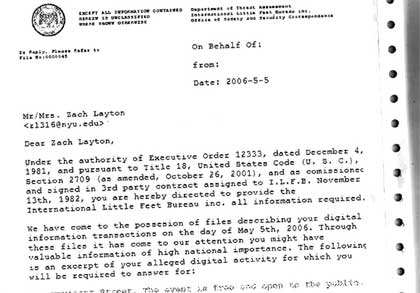 In a Swedish bill, communication profiles, aka sociograms or traffic data, will give authorities a new lead into investigations. While politicians argue that no personal data will be recorded outside particular narrow investigations, "traffic data" is not considered personal data as such.
During this summer the Swedish television sent news that such traffic data was to be stored in a database called Titan, on a super computer owned by the Swedish surveillance intelligence, FRA. The bad news is that this database will probably not be for military intelligence matters only.
People are worried that this will affect how we conduct business and talk to lawyers or journalists. Swedish blogger Mark Klamberg is one of many who has shed light on the many loopholes. Even if messages are not recorded, the context of the communication might very well be stored as metadata and used later. The new Swedish signal surveillance bill grants the FRA, rights to copy all Internet traffic crossing the Swedish borders.
So what do I think? Here is a list of useful traffic-data patterns:
- E-mails and IP-number
- E-mail sender and receiver
- Google search terms and IP-numbers.
- Membership logins at web sites.
And that would be a lot like what people think is illegal in the US...
2008-10-18
Telecom package lost in backroom negotiations?

- Amendment 166, recently voted for in first reading in the EU-parliament, seems to have been lost in the records of the EU-Council. Its a shame and a loss for the rights of Internet users. I sincerely hope that responsible member states will bring the Council up to speed. Sarkozy seems to pressure the Council for a Minitel like version of Internet. Locked and filtered.
UPDATE:
Its a terrible thing to see laws written without clear aim or leadership. Copyright enforcement on the net is a peril for fair use and net neutrality as much as it is needed. We need a clear voice from politicians on EU directives, or the process will harmonize the EU into a very ugly centralized and censured version of Internet.
What if your ISP would had to do the policing of your blog or website, regardless of what YouTube or website you publish on?
Its right when creators get access to infringing publishers and can remove the material and seek reasonable damages.
Me, I think:
* Publishing or uploading without consent is infringing, but not downloading. Downloading is NOT stealing.
* Laws against processing "protected" information are stupid and dangerous.
* Names of users of IP-numbers from ISP:s should get delivered by court descision, not too easy.
* Automated filtering of Internet for "unlawfull content" is not OK.
* Automated search for infringements should be done just as anyone can do it.
More services will save the day. No one wants to download everything to their computers.
IPTegrity writes about the Council trouble:
http://www.iptegrity.com/index.php?option=com_content&task=view&id=181&Itemid=9
Bloggers in Sweden: HAX, Mark Klamberg, Oscar Swartz
Software patents take on the market
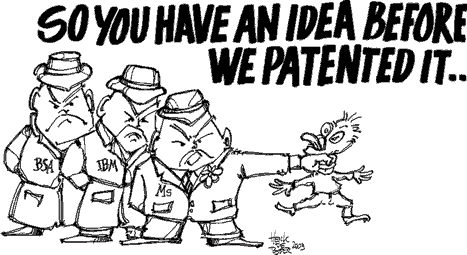 From a C-Net interview with Horacio Gutierrez, IPR-lawyer at Microsoft, its clear that patent insurance still is the game to curb competition. Even though Microsoft is paying ten times its patent income in patent charges, trials and fees, it manages to find profit in the larger loss and risk for all. The idea is to sell an insurance against patent risk called patent indemnification to partners. Selling patent indemnification covers patents and patent lobbying costs by creating new alliances and effectively kills independent actors. Its just what Bill Gates concluded in the early days of Microsoft:
"If people had understood how patents would be granted when most of today's ideas were invented and had taken out patents, the industry would be at a complete standstill today. ... The solution is patenting as much as we can. A future startup with no patents of its own will be forced to pay whatever price the giants choose to impose. That price might be high. Established companies have an interest in excluding future competitors." (Quoted by Fred Warshofsky "The Patent Wars" of 1994)
In this new world, the business models would be:
- Cross-license if you can level with Microsoft's patent and pay the trolls whatever.
- Get indemnification and lock yourself within the agreements of your new host. Microsoft perhaps?
- Don't develop any software liability. Instead - become a troll, get patents and sue!
2008-10-09
UKPO vs EPO 1-1
Confusing. Bad. Fuzzy. Seems UKPO lost its appeal against Symbians effort to grant software patents in the UK. The ruling from yesterday can be found here: http://www.bailii.org/ew/cases/EWCA/Civ/2008/1066.html
The ruling fails to understand that the contribution of making a data program run in less steps, faster independent of hardware, is within the computer program exclusion:
"Stage 2 Identify the contribution:
A program which makes a computer operate on other programs faster than prior art operating programs enabled it to do by virtue of the claimed features.
Stage 3 Is that solely excluded matter?
No, because it has the knock-on effect of the computer working better as a matter of practical reality.
Stage 4 Is it technical?
Yes, on any view as to the meaning of the word 'technical'" (paragraph 59).
IP-Kitten has a software patent happy story about this:
http://ipkitten.blogspot.com/2008/10/symbian-appeal-dismissed.html
EPO seems to increasingly rebell the EPC at the same time. In the latest EPO Gazette there is an article about patenting "presentation of information", where EPO seems to grant them just like software patents, using the 'technical' effect trick. The EPO is still mixing up problem with contribution in its shady business model.
The patent system seems too greedy to save itself from self destruction.
UPDATE: Article that I missed about this in times:
http://business.timesonline.co.uk/tol/business/law/article4907993.ece
UPDATE2 22/10, FFII comment on judgement:
http://news.zdnet.co.uk/itmanagement/0,1000000308,39171034,00.htm
2008-10-04
Cost of running European patent litigation under European Court of Justice?
 Special patent courts should have a more general court watching in the interest of a more balanced interpretation. But proponents of a new European patent court seem eager to stand clear of any oversight, arguing that it would only cause economic harm. I disagree.
Having the European Court of Justice (ECJ) as top court for the proposed European patent courts (EPLA) could perhaps avoid broad patent where they cause harm to innovation. The US Supreme Court has been critical to the same kind of federal special patent court and its record in granting ever broader patents. But some member states of Europe disagree with the idea of ECJ as top instance, amongst them Sweden, arguing that the cost of having an extra instance would be a high burden on litigants. But would the cost really be that high?
Lets compare the extra costs with the same setup at the EU Trademark Court where ECJ is the top instance:
Here are all ECJ-rulings on trademarks: (2008=5 2007=8 2006=8, 2005=4, 2004=11)
http://oami.europa.eu/ows/rw/pages/CTM/caseLaw/ECJCases.en.do
Court of First instance (CFI, under ECJ): (2008=14 2007=18 2006=12 2005=4 2004=15 )
http://oami.europa.eu/ows/rw/pages/CTM/caseLaw/appealsCFI.en.do
Appels at first instance (2008=113 2007=68 2006=45 2005=63 2004=35)
http://oami.europa.eu/ows/rw/pages/CTM/caseLaw/appealsOffice.en.do
Judgements in national (community) trade mark courts: (2008=73 2007=100 2006=77 2005=62 2004=42)
http://oami.europa.eu/ows/rw/pages/CTM/caseLaw/judgementsCTMCourtsList.en.do
Run down:
2008: 73 -> 113 -> 14 -> 5
2007: 100 -> 68->18->8
2006: 77 -> 45->12->8
2005: 62 -> 63->4->4
2004: 42 -> 35->15->11
So the risk of a ECJ appeal is about 5-10% in trademarks. Is that such a terrible risk in comparison with the cost of patent inflation?
2008-10-01
Off topic research on patents vs copyrights in software
I would like to see more real patent claims and more nuts and bolts examples of what should be protected to serve progress and innovation.
Yesterday I went to a seminar where Sanna Wolk, law scholar at the Stockholm University, made a presentation of her software protection research so far. She made quite a thorough presentation on the difference in patent vs copyright infringements, but without assuming any real borders for patents at all.
This is quite worrying, since the possible extent of patentable subject matter make a huge difference on how the patent legislation overlap with copyright. [like in: Can I patent this film?]
It's as if many academic patent researchers completely ignore the first test in European patent law, the test on if then contribution falls within the exclusions from what we call patentable invention...
Perhaps its too hard to understand what is practical when it sounds technical. Perhaps its the T in IT that does it? It feels as if some law scholars just decide that some things are more technical than other things that are creative and bag them without understanding the art in this matter. This is perhaps what upsets software developers the most in the issue of software patents.
Several core issues in software patents where not mentioned, such as:
But then again - she is not done with her paper yet. I do hope that she asks the professionals, those skilled in the art. Just as those skilled in the art can learn from lawyers.
Yesterday I went to a seminar where Sanna Wolk, law scholar at the Stockholm University, made a presentation of her software protection research so far. She made quite a thorough presentation on the difference in patent vs copyright infringements, but without assuming any real borders for patents at all.
This is quite worrying, since the possible extent of patentable subject matter make a huge difference on how the patent legislation overlap with copyright. [like in: Can I patent this film?]
It's as if many academic patent researchers completely ignore the first test in European patent law, the test on if then contribution falls within the exclusions from what we call patentable invention...
Perhaps its too hard to understand what is practical when it sounds technical. Perhaps its the T in IT that does it? It feels as if some law scholars just decide that some things are more technical than other things that are creative and bag them without understanding the art in this matter. This is perhaps what upsets software developers the most in the issue of software patents.
Several core issues in software patents where not mentioned, such as:
- Interoperability exceptions, as asked for by Sun and Google during the EU-directive on software patents.
- Program claims, where publication is a direct infringement, not even suggested by the EU-commission.
But then again - she is not done with her paper yet. I do hope that she asks the professionals, those skilled in the art. Just as those skilled in the art can learn from lawyers.
Subscribe to:
Posts (Atom)